Difference Between Pump and Compressor
Published: 12 Jul 2025
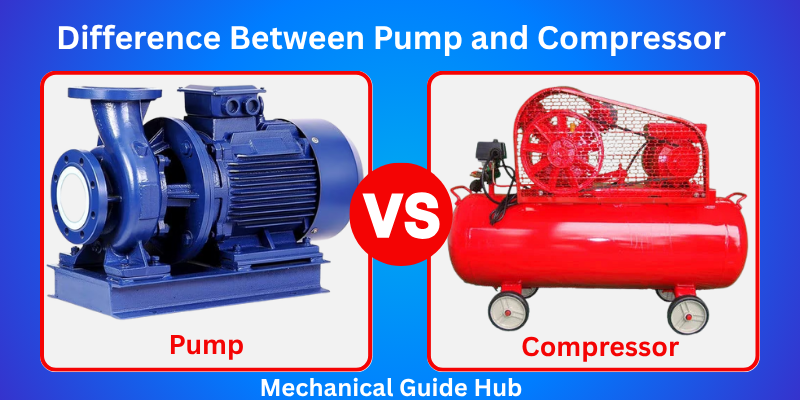
Pumps and compressors transfer liquids and gases in different systems. We often hear these words in industries like manufacturing, agriculture, and even at home. But do you know what makes a pump different from a compressor? Both help move substances, but they work in different ways and for various purposes. Let’s explore the main differences to help you understand when to use each one.
Pumps generally operate at low to medium pressure and focus on moving large amounts of liquid.
Pump Vs Compressor: The Key Differences
Pump
- A pump moves liquids such as water, oil, chemicals, and other fluids that cannot be compressed.
- Pumps move liquid without changing its volume.
- Pumps are often more energy-efficient since they only move liquids.
- It converts mechanical energy into kinetic energy to push liquids through pipes.
- The fluid keeps the same volume as it moves through.
- Operates at low to medium pressure; mainly focused on fluid flow.
- More energy-efficient; moving liquids requires less energy.
- Pumps move water, oil, chemicals, and waste in homes and farms.
- A simpler design usually includes a motor, an impeller, a casing, shaft.
- Used to transfer large liquid volumes at steady speeds.
- Easier to maintain, with fewer moving parts.
- Generally less expensive.
- Works with incompressible fluids (liquids).
- Typically quieter with less vibration.
- Does not store fluid; it just moves it.
- Does not have a compression ratio because it does not compress the fluid.
- Fluids typically do not experience a significant temperature change during pumping.
- The pump moves fluid without altering its physical or chemical properties.
- Certain pumps (like positive displacement pumps) can handle viscous fluids like oils or slurries.
- Can be installed close to the fluid source or discharge point.
Compressor
- A compressor moves gases like air, natural gas, or other compressible fluids.
- It squeezes gas to raise its pressure.
- Compressors handle high pressure by compressing gases into smaller volumes.
- Compressors often use more energy due to the effort of squeezing gas.
- It reduces gas volume to hold energy in less space.
- Compressing the gas reduces its volume.
- Operates at high pressure; mainly focused on pressure increase.
- Consumes more energy; compressing gases is energy-intensive.
- Used in homes and industries, compressors handle air, gas, and cooling tasks.
- More complex, and includes a motor, storage tank, valves, and cooling systems.
- Typically handles lower flow rates but increases pressure significantly.
- Maintenance is difficult because of complex parts and high operating pressure.
- Usually costs more due to complexity and pressure requirements.
- Works with compressible fluids (gases).
- It can be noisy and cause vibrations due to high pressure and moving parts.
- Generally, has a storage tank to store compressed air or gas.
- Has a compression ratio always above one, showing how much the gas is compressed.
- Compressing gas generates heat, so compressors often require cooling systems to manage temperature.
- Compression can affect the gas properties, such as increasing temperature and density.
- Not suitable for viscous fluids as it only compresses gases.
- Usually installed with safety and ventilation measures due to high pressure and heat.
Conclusion
In simple terms, pumps and compressors do similar jobs but for different materials. Pumps move liquids without changing their volume, while compressors increase the pressure of gases by squeezing them into smaller spaces. Knowing the difference helps you choose the right machine for your needs, whether it’s for a factory, farm, or home.
FAQs
Usually not.Usually no. Compressors handle gases, and pumps handle liquids. They are built differently. However, some special vacuum pumps may work like compressors in certain cases.
No. A pump moves liquids without changing their volume. A compressor works only with gases and increases their pressure by reducing their volume.
Both increase the pressure of a fluid to move it through a system. They convert mechanical energy into fluid energy and are essential in many industrial and domestic applications.
No. A pump moves liquids without changing their volume, while a compressor works only with gases and compresses them to increase pressure.
Yes, pumps are generally less expensive than compressors because they have simpler designs and operate at lower pressures.



- Be Respectful
- Stay Relevant
- Stay Positive
- True Feedback
- Encourage Discussion
- Avoid Spamming
- No Fake News
- Don't Copy-Paste
- No Personal Attacks
- Be Respectful
- Stay Relevant
- Stay Positive
- True Feedback
- Encourage Discussion
- Avoid Spamming
- No Fake News
- Don't Copy-Paste
- No Personal Attacks
