Butterfly Valve: Parts, Working, Types, Advantages, Disadvantages & Applications
Published: 23 Dec 2025
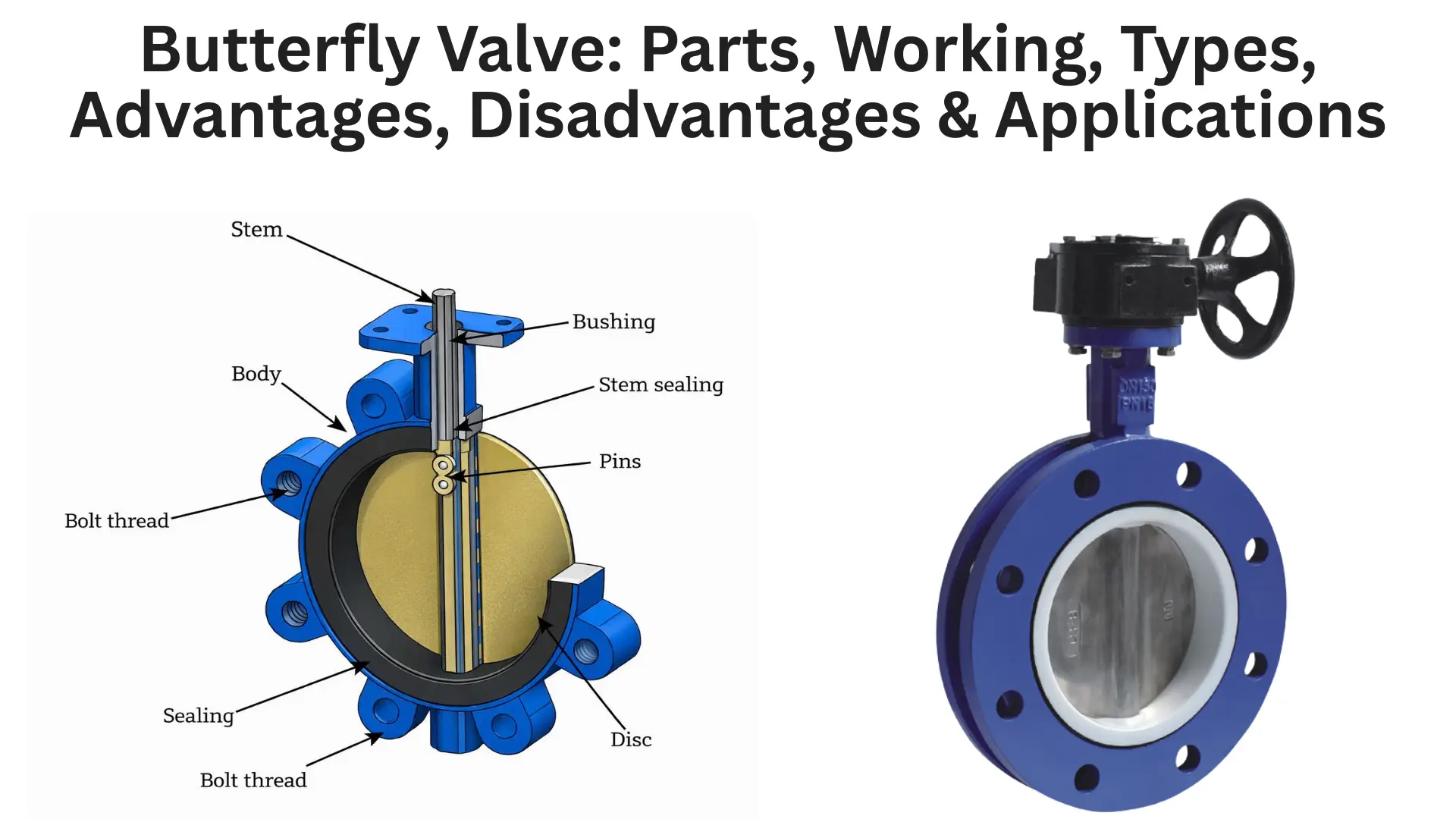
In this article, we will discuss what a butterfly valve is, its parts and their functions, the working principle, operation, types, advantages, disadvantages, and applications. Butterfly valves are widely used in various industries due to their simple design, cost-effectiveness, and versatility. By reading this guide, you will understand how these valves operate, learn about their key components, and discover why they are preferred for controlling fluid flow in pipelines.
What is a Butterfly Valve?
A butterfly valve is a quarter-turn valve that regulates the flow of liquids or gases in a pipe. It consists of a circular metal disc mounted on a turning shaft. When the valve is closed, the disc blocks fluid flow, and when open, the disc rotates to allow flow. Butterfly valves are lightweight, compact, and cost-effective compared to other valve types
Butterfly Valve Parts and Their Functions
Here are the important parts of a butterfly valve and their functions.
Body: The body houses all internal components and connects to the pipeline. Made of cast iron, stainless steel, or PVC, it provides strength and durability.
Disc: The disc rotates to control fluid flow. It can be made of stainless steel, rubber-coated, or plastic, depending on the application.
Stem: The stem connects the disc to the actuator or handle, transmitting torque to rotate it. Stainless steel is commonly used for its strength and corrosion resistance.
Gasket: The gasket ensures a tight seal between the valve body and pipeline, preventing leaks and maintaining system integrity.
Seat: The seat provides a sealing surface for the disc when closed. It can be soft (rubber or Teflon) or metal, based on the pressure and temperature requirements.
Bushing: The bushing supports the stem and reduces friction during rotation, enhancing valve longevity.
Pins: Pins secure components like the disc and stem, ensuring smooth and stable operation.
Packing: Packing prevents leaks around the stem and ensures smooth valve movement over time.
How Does a Butterfly Valve Work?
- A butterfly valve is a quarter-turn valve, meaning it opens or closes by rotating the disc 90 degrees. The disc is mounted on a stem that is connected to a handle, gear, or actuator. When you turn the handle or operate the actuator, the stem rotates the disc, allowing or stopping fluid flow.
- When the valve is closed, the disc sits perpendicular to the pipeline, blocking the passage of fluid completely. This tight seal ensures no leakage, making it effective for isolating sections of a piping system.
- When the valve is open, the disc rotates to become parallel with the flow direction, allowing fluid to pass through freely. By adjusting the disc to intermediate positions, you can also control the flow rate, making it suitable for applications requiring both on/off and flow regulation.
- The simplicity of this quarter-turn mechanism allows for fast operation, low maintenance, and reliable performance at different pressures and temperatures.
Types of Butterfly Valve
Here are the main types of butterfly valve:
1. By End Connection:
Wafer Butterfly Valve: It fits snugly between two pipe flanges, making it compact and easy to install. It is commonly used in water supply and wastewater treatment systems due to its simplicity and reliability.
Lug Butterfly Valve: It features threaded inserts that allow end-of-line installation or isolation without shutting down the whole system. It is ideal for industrial systems requiring maintenance or for fire protection applications.
Double-Flanged Butterfly Valve: It is equipped with flanges on both ends, providing strong connections for high-pressure applications. It is suitable for larger pipelines and heavy-duty industrial use where durability is critical.
Butt-Weld Butterfly Valve: It is welded directly into the pipeline, offering maximum strength and leak-proof connections. It is suitable for high-pressure and high-temperature applications in demanding industrial processes.
2. By Disc and Stem Design:
Zero Offset Butterfly Valve: It has a basic design with minimal offsets, suitable for low-pressure applications. It provides reliable operation for simple fluid control tasks.
Double Offset Butterfly Valve: It features two offsets that reduce friction and wear between the disc and seat. It improves sealing performance and durability, making it ideal for high-pressure and high-temperature environments.
Triple Offset Butterfly Valve: It has three offsets that form a conical sealing surface, eliminating contact between the disc and seat. It prevents wear and leakage, making it perfect for critical processes like refining, cryogenic, and power generation applications.
By Actuation:
Lever-Operated: It is a simple, manual operation using a lever. It is suitable for small valves or for applications where frequent adjustment is not required.
Gear-Operated: It uses a handwheel and gear mechanism to provide higher torque for operating larger valves. It allows precise control in larger systems where manual effort alone is insufficient.
Actuated: It is operated electrically, pneumatically, or hydraulically for automated systems. It allows for remote control, fast operation, and precise flow regulation in complex industrial processes.
Advantages of Butterfly Valves
Here are some benefits of using Butterfly Valves:
- Lightweight and compact design makes them easy to install, even in tight spaces.
- More economical than other valve types, especially for large pipelines.
- Quarter-turn operation allows fast opening and closing with good flow control.
- Suitable for various fluids and available in different materials for diverse applications.
- A simple design means lower maintenance and reduced downtime.
- High-performance types can handle high pressure and temperature reliably.
Disadvantages of Butterfly Valves
Here are some drawbacks of using Butterfly Valves:
- It may not provide a perfect seal under very high pressure.
- Discs in the flow path can cause slight pressure drops and turbulence.
- Not ideal for fluids with large solid particles, which can damage the valve.
- Large valves may require actuators due to high torque requirements.
- Less precise for fine flow adjustments compared to globe valves.
Applications of Butterfly Valves
Here are some common applications of Butterfly Valves:
- Widely used in water supply and wastewater treatment systems for flow control.
- Common in the chemical and pharmaceutical industries for handling various fluids.
- Employed in oil and gas pipelines for isolation and flow regulation.
- Used in power plants and the energy sectors for high-pressure and high-temperature service.
- Found in fire-protection systems for quick shut-off and reliable operation.
- Suitable for HVAC systems to control air and liquid flow efficiently.
Conclusion
In conclusion, this article covered what a butterfly valve is, its parts and their functions, working principles, types, advantages, disadvantages, and applications in detail. We hope you found this information useful and gained a clearer understanding of butterfly valves and their importance in various industries.



- Be Respectful
- Stay Relevant
- Stay Positive
- True Feedback
- Encourage Discussion
- Avoid Spamming
- No Fake News
- Don't Copy-Paste
- No Personal Attacks
- Be Respectful
- Stay Relevant
- Stay Positive
- True Feedback
- Encourage Discussion
- Avoid Spamming
- No Fake News
- Don't Copy-Paste
- No Personal Attacks
