Types of Conveyor Systems: Advantages, Disadvantages, and Applications
Published: 26 Dec 2025
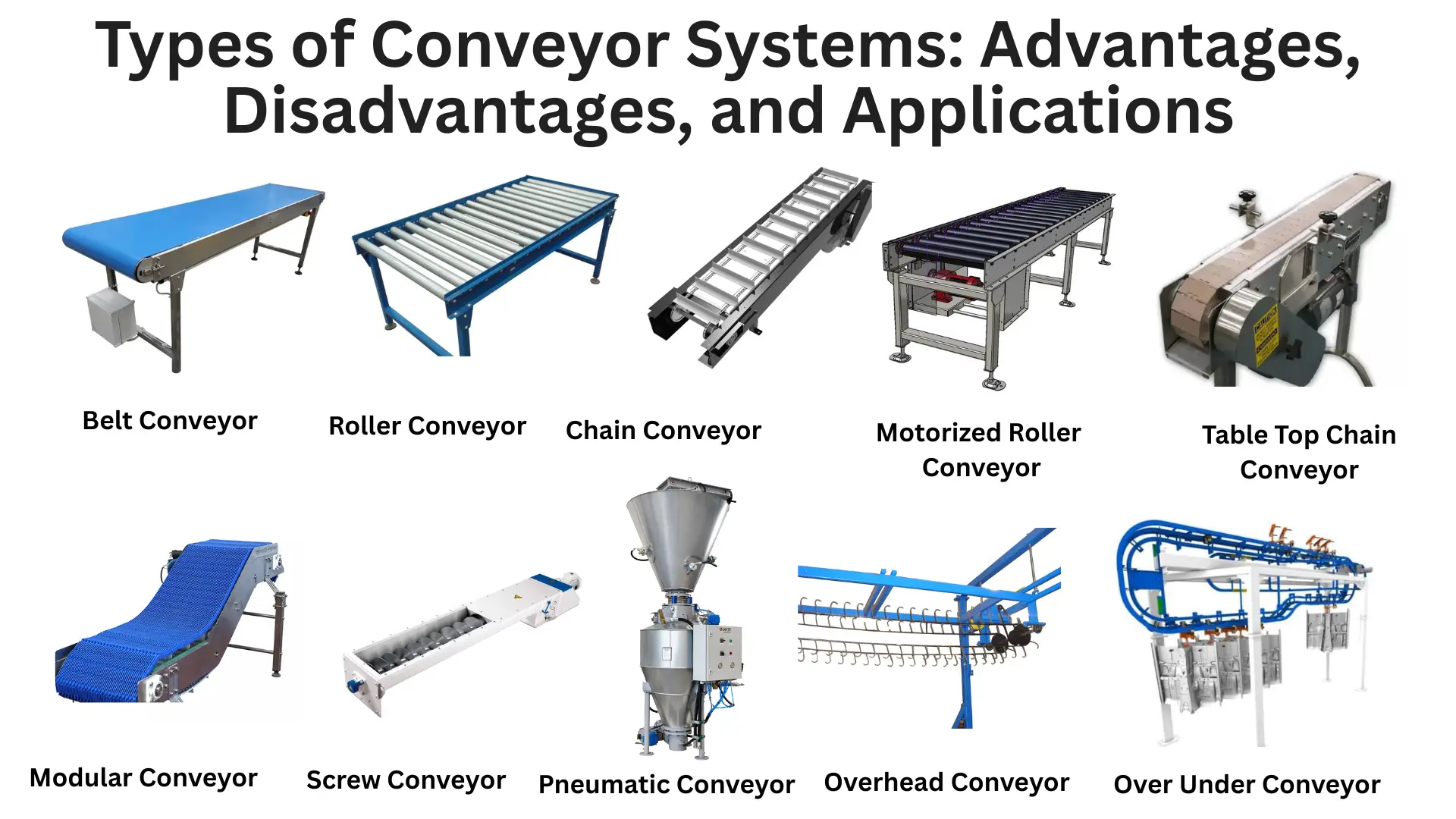
In this article, we will discuss what a Conveyor System is, its types, advantages, disadvantages, and applications. Whether you are a beginner in industrial automation, a student, or a professional exploring materials handling solutions, this guide will provide a clear understanding of how conveyor systems operate and why they are essential for modern industries.
What is a Conveyor System?
A conveyor system is a mechanical device or assembly of equipment designed to transport materials, products, or goods from one location to another efficiently and safely. Used across industries such as manufacturing, food processing, logistics, and packaging, conveyors reduce manual labor, minimize handling errors, and improve productivity.
Modern conveyor systems can be powered or unpowered, automated, and integrated with advanced technologies like sensors, robotics, and data analytics to optimize operations and ensure workplace safety.
Different Types of Conveyor Systems and Their Uses
1. Belt Conveyors
Belt conveyors are one of the most widely used systems, consisting of a continuous loop belt rotating around pulleys. They efficiently transport materials over long distances and can handle a wide range of products, from bulk powders to packaged goods. They are commonly used in warehouses, airports, and food processing plants.
2. Roller Conveyors
Roller conveyors use cylindrical rollers to move goods along a fixed path. They can be gravity-powered or motorized and are ideal for transporting boxes, pallets, or rigid items. These conveyors are popular in assembly lines, distribution centers, and packaging operations.
3. Chain Conveyors
Chain conveyors employ a continuous chain to move heavy or oversized items, making them suitable for industries like automotive, manufacturing, and pharmaceuticals. They can handle pallets, containers, and industrial parts. While robust, they require more maintenance compared to belt conveyors.
4. Motorized Roller Conveyors
Motorized roller conveyors combine rollers with a motorized drive system, allowing precise control of speed and movement. These conveyors are used in high-volume operations where accumulation, sorting, or staging of goods is required.
5. Table Top Chain Conveyors
Table top chain conveyors use interlinked chains to transport items smoothly and accurately. They are highly durable and widely used in the packaging, beverage bottling, and material handling industries where precise movement is crucial.
6. Modular Conveyors
Modular conveyors feature interlocking belt segments made of plastic or other materials. They provide flexibility, easy maintenance, and adaptability to curves, elevations, and unusual layouts. Commonly used in food processing, pharmaceuticals, and packaging, modular conveyors are hygienic and easy to clean.
7. Screw Conveyors
Also called auger conveyors, screw conveyors use a rotating helical blade to move materials like grains, powders, and semi-solids within a tube. They are efficient for transporting bulk materials but may cause breakage for delicate items, and are less suitable for steep inclines.
8. Pneumatic Conveyors
Pneumatic conveyors use air pressure or vacuum to move fine powders, granules, or pellets through enclosed pipelines. They are widely used in the food, pharmaceutical, chemical, and agricultural industries for hygienic, dust-free transport.
9. Overhead Conveyors
Overhead conveyors utilize vertical space to transport goods while saving floor area. They are ideal for assembly lines, automotive production, and environments where space optimization is crucial. Products can hang or be attached to rails for movement.
10. Over Under Conveyors
Over-under conveyors are specialized systems designed to move materials at multiple levels simultaneously. These are often used in high-volume processing and packaging operations where space efficiency and flow control are priorities.
Advantages of Conveyor Belt Systems
Here are some key benefits of using a conveyor belt system
- Automates material movement, reducing manual labor.
- Minimizes worker injuries associated with manual handling.
- Maintain a steady and controlled transport of goods.
- Can handle a wide variety of materials, shapes, and weights.
- Easily integrates with sensors, robotics, and data analytics for smarter operations.
Disadvantages of Conveyor Belt Systems
Here are some potential drawbacks of conveyor belt systems:
- Installation and setup can be expensive.
- Requires regular inspection, cleaning, and replacement of worn components.
- Fixed layouts may not adapt easily to facility changes.
- Motorized systems can use significant power.
- High speed or improper handling may damage delicate items.
Applications of Conveyor Belt Systems
Here are some common applications of conveyor belt systems:
- Transporting raw materials, components, and finished products in manufacturing.
- Hygienic movement of packaged and raw food items.
- Efficient sorting, storage, and delivery of goods in warehouses and distribution centers.
- Safe handling of powders, tablets, and delicate products in pharmaceuticals.
- Transporting ores, coal, and aggregates in the mining and bulk material industries.
- Moving luggage and parcels efficiently in airports and logistics centers
Conclusion
In conclusion, in this article, we covered what a conveyor system is, along with its types, advantages, disadvantages, and applications in detail. We hope you found this information helpful.


- Be Respectful
- Stay Relevant
- Stay Positive
- True Feedback
- Encourage Discussion
- Avoid Spamming
- No Fake News
- Don't Copy-Paste
- No Personal Attacks
- Be Respectful
- Stay Relevant
- Stay Positive
- True Feedback
- Encourage Discussion
- Avoid Spamming
- No Fake News
- Don't Copy-Paste
- No Personal Attacks
