Different Types of Stud Bolts and Their Uses
Published: 21 Dec 2025
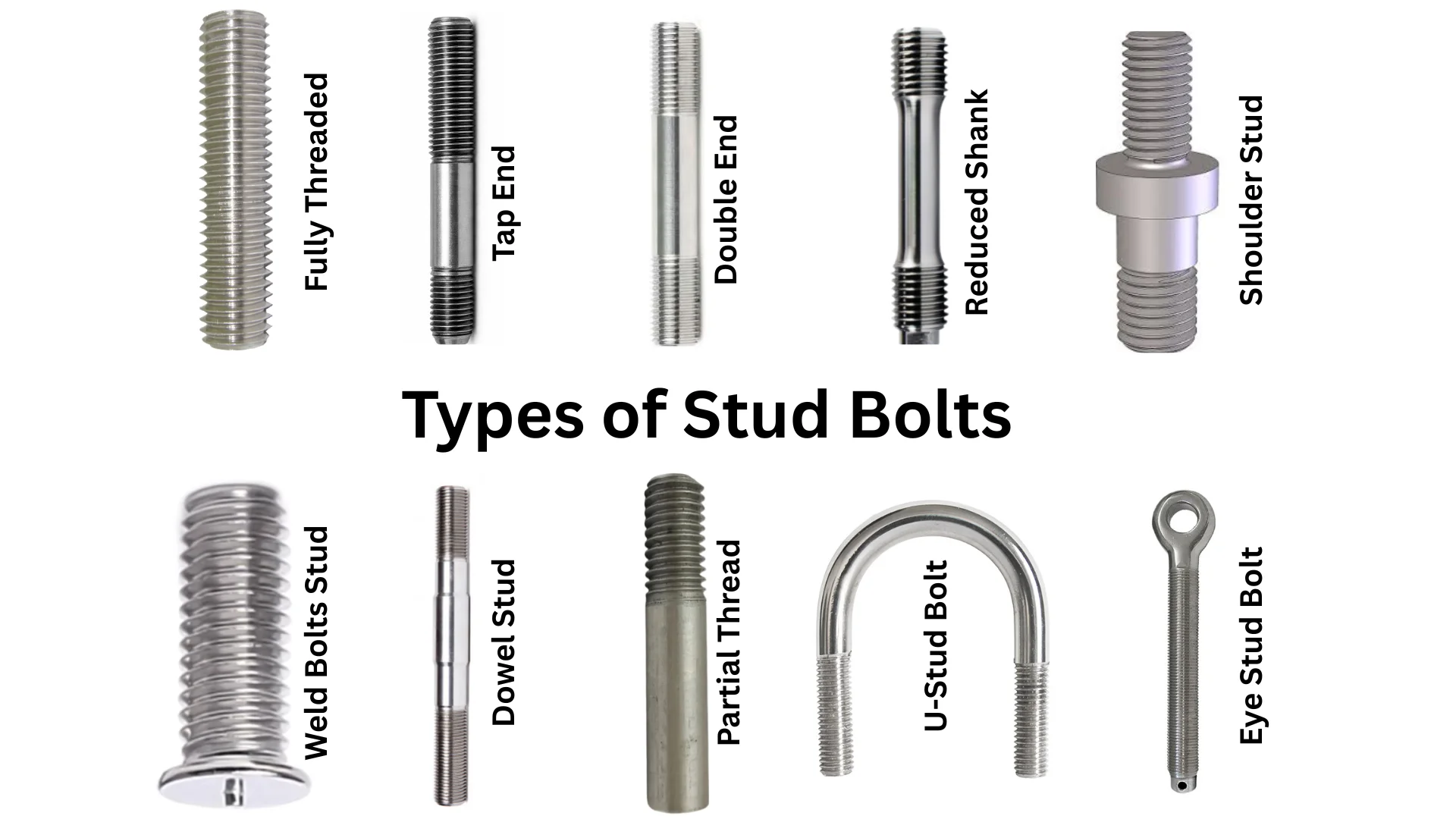
In this article, we will discuss what stud bolt is, the types of stud bolts and their uses, and their applications. Stud bolts are simple yet very important fasteners that hold machines, pipes, and structures together. You will learn what they are, how they work, and where each type is used. Let’s start by understanding it clearly and easily.
What is Stud Bolt?
A stud bolt is a long rod with threads on both ends or along the full length. It does not have a head like normal bolts. Stud bolts help join two parts tightly by using nuts on both ends. They are strong, simple, and easy to install. You often see them in industries like oil and gas, power plants, and heavy machinery.
Types of Stud Bolts and Their Uses
Here are the main types of stud bolts and how people use them:
1. Fully Threaded Stud Bolts
Fully threaded stud bolts have threads along the entire length of the rod, providing a firm and uniform clamping force when used with nuts on both ends. They are easy to install and remove, making them suitable for maintenance-heavy applications. These studs are especially effective in high-pressure systems, ensuring secure and consistent connections. Common applications include flange joints, boilers, pressure vessels, and structural steel frameworks where maximum grip is needed.
2. Tap End Stud Bolts
Tap end studs feature unequal threads on both ends: one end has a short thread that screws into a tapped hole, while the other end has a longer thread for a nut. This design allows installation in blind or hard-to-reach holes, offering flexibility for maintenance. They are widely used in engine blocks, pumps, compressors, and turbines, where secure yet accessible bolting is necessary. Tap end studs provide controlled tension and stability, making them ideal for critical machinery.
3. Double End Stud Bolts
Double-end studs have equal threads on both ends with a non-threaded center section, which provides better alignment and additional strength. They are ideal for applications where the parts must be held in exact position, ensuring accurate assembly. These bolts are commonly used in heavy machinery, automotive engines, structural joints, and mounting brackets. Their design also helps distribute load evenly, reducing the risk of joint failure under stress.
4. Reduced Shank Stud
Reduced shank studs feature a thinner center section between the threaded ends, which helps to reduce stress concentration and allow thermal expansion. This design improves the flexibility and fatigue resistance of the stud under dynamic or vibrating loads. They are frequently used in aircraft engines, marine turbines, power generation systems, and vibrating machinery, where both strength and adaptability are required. Reduced shank studs are also lighter, making them easier to handle in complex assemblies.
5. Shoulder Stud
Shoulder studs include an unthreaded shoulder or stop in the middle of the stud, allowing precise placement and accurate alignment in assemblies. This design prevents the stud from being over-tightened and ensures repeatable positioning in equipment. They are often used in gearbox housings, valve bodies, engines, and high-precision machinery, where exact alignment is critical. Shoulder studs enhance the overall stability and longevity of the joint by controlling movement.
6. Weld Bolts Studs
Welded studs are designed with one end permanently welded to a base metal, while the other end is threaded for nut attachment. They are ideal for applications with limited access or where the stud must remain fixed in place permanently. Weld studs are commonly used in shipbuilding, heavy steel structures, pipe supports, and mounting panels. This type of stud provides secure and reliable fastening without the risk of loosening over time.
7. Dowel Studs
Dowel studs are smooth cylindrical rods used for precise alignment in assemblies rather than clamping. They ensure that components are perfectly positioned, which is crucial for machinery that requires high accuracy. Dowel studs are widely applied in engine mounts, machine tool assemblies, and precision equipment, where alignment is critical. They enhance repeatability and stability during assembly and operation.
8. Partial Thread Stud Bolt
Partial thread studs feature threads only at both ends, leaving a plain central section for better load distribution and strength. This design is effective in high-shear applications, as it prevents localized stress along the stud. They are commonly used in mechanical couplings, machine joints, and rotating parts. Partial thread studs also allow for controlled tensioning, reducing the risk of loosening under vibration.
9. U-Stud Bolt
U-stud bolts are U-shaped threaded rods, specifically designed to clamp pipes, rods, or round objects securely. They are versatile and provide an adjustable grip depending on the application. U-stud bolts are widely used in industrial piping, marine applications, and heavy-duty pipelines. Their shape ensures stable fastening in applications where conventional straight studs are impractical.
10. Eye Stud Bolt
Eye studs are threaded rods with a looped or eye-shaped head, allowing them to be used for lifting, rigging, or securing cables and chains. They combine the functionality of a stud bolt with the flexibility of an attachment point. Eye studs are commonly used in construction, mechanical lifting, marine operations, and rigging systems. They provide safe and reliable attachment points, especially in heavy-duty lifting or securing tasks.
Advantages of Stud Bolts
Here are some advantages of stud bolts:
- Stud bolts provide high strength and can handle heavy loads and pressure.
- They allow easy installation and removal without disassembling the entire system.
- They ensure precise alignment and uniform stress distribution for secure connections.
- Available in various materials and sizes to suit different applications.
- Durable and reliable, ideal for high-temperature, high-pressure, and corrosive environments.
Disadvantages of Stud Bolts
Here are some disadvantages of stud bolts:
Stud bolts are more expensive than standard bolts, increasing project costs.
Installation can take longer due to precise alignment and the use of two nuts.
High-stress applications may cause thread wear, limiting reusability.
Regular inspection and torque checks are needed to prevent loosening.
Some types require specialized tools for proper installation.
Conclusion
In conclusion, in this article, we covered what a stud bolt is, the types of stud bolts and their uses, and their applications in detail. I hope you found this simple and clear guide helpful.




- Be Respectful
- Stay Relevant
- Stay Positive
- True Feedback
- Encourage Discussion
- Avoid Spamming
- No Fake News
- Don't Copy-Paste
- No Personal Attacks
- Be Respectful
- Stay Relevant
- Stay Positive
- True Feedback
- Encourage Discussion
- Avoid Spamming
- No Fake News
- Don't Copy-Paste
- No Personal Attacks
