Tower Crane Parts Name and Their Functions
Published: 9 Oct 2025
If you’ve ever seen a busy construction site, you must have noticed a tall tower crane standing up high above everything. These powerful machines help lift heavy materials like steel, concrete, and equipment safely to great heights. To understand how they work, let’s explore the tower crane parts name and their functions that make these machines strong, stable, and efficient.
Tower Crane Parts Name and Their Functions
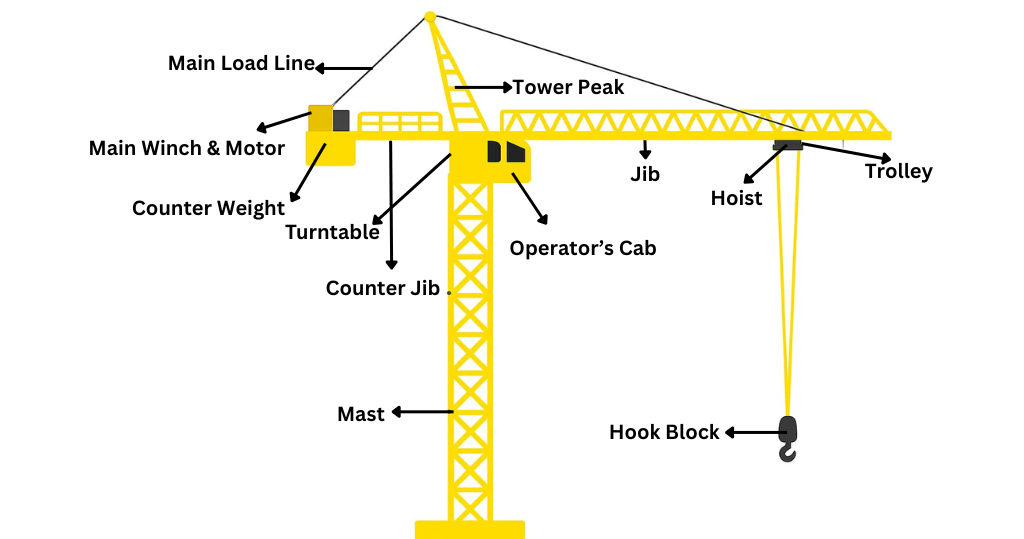
1. Base
The base is the foundation of the tower crane. It’s bolted securely to a large concrete pad, giving the entire structure stability and balance. Without the base, the crane wouldn’t be able to stand safely or handle heavy loads.
2. Mast (Tower Section)
The mast, or tower, gives the crane its tall height. It connects the base to the upper parts and provides strong vertical support. Made of steel sections, it ensures the crane stays firm even in windy or heavy-load conditions.
3. Tower Peak
The tower peak sits at the very top of the mast. It connects the main jib and counter jib, helping distribute weight evenly. This part plays a key role in keeping the crane balanced while lifting large materials.
4. Slewing Unit (Turntable)
The slewing unit, also called the turntable, allows the crane to rotate in any direction. It contains powerful gears and motors that help move the jib smoothly. This rotation makes it easier to position loads across the construction site.
5. Main Winch & Motor
The main winch and motor are the lifting power sources of the crane. The motor drives the winch drum, winding or unwinding the main load line to lift or lower materials. They ensure steady movement during lifting operations.
6. Main Load Line
The main load line is a thick steel rope used to lift heavy loads. It passes through pulleys and connects to the hook block. This strong cable ensures safe and smooth handling of materials during operation.
7. Jib (Working Arm)
The jib is the long horizontal arm extending from the crane’s top. It carries loads outward from the tower and reaches far distances. This arm allows the crane to deliver materials exactly where they are needed.
8. Counter Jib
The counter jib is the shorter arm on the opposite side of the main jib. It holds counterweights that balance the crane during lifting. This balance prevents the crane from tipping over when carrying heavy materials.
9. Counter Weight
The counterweight provides perfect balance to the crane. These heavy concrete blocks offset the weight being lifted on the main jib. Without them, the crane would become unstable or unsafe during operation.
10. Operator’s Cab
The operator’s cab is where the crane operator sits and controls all movement. It’s equipped with modern controls, safety systems, and comfortable seating. From here, operators can lift, move, and place loads with great precision.
11. Hoist
The hoist system is responsible for raising and lowering loads. It works with the winch and load line to control the lift height. A smooth hoist system ensures steady movement and accurate positioning of heavy materials.
12. Trolley
The trolley moves along the jib to adjust the load’s position. It carries the hoist and hook block while sliding back and forth. This movement helps place loads exactly where they are needed across the working area.
13. Hook Block
The hook block connects the load line to the object being lifted. It includes pulleys and hooks to hold materials securely. This part ensures that loads are carried safely and lowered without sudden movement.
14. Mist (Mast Section)
The mist, or mast section, is the middle part of the tower. It consists of strong modular steel frames that give height and strength. It keeps the crane upright, steady, and ready for heavy-duty lifting.
Conclusion
Every part of a tower crane plays a vital role in lifting and balancing heavy materials. From the strong base to the powerful winch and motor, each section works in harmony to build tall structures safely. Knowing the tower crane parts name and their functions helps you understand how these giants of construction keep our skylines growing higher every day.


- Be Respectful
- Stay Relevant
- Stay Positive
- True Feedback
- Encourage Discussion
- Avoid Spamming
- No Fake News
- Don't Copy-Paste
- No Personal Attacks
- Be Respectful
- Stay Relevant
- Stay Positive
- True Feedback
- Encourage Discussion
- Avoid Spamming
- No Fake News
- Don't Copy-Paste
- No Personal Attacks
